
The answer is not always as straightforward as you might think. There is a significant overlap in the applications for these two aluminum filler alloys, and in many cases either one can be used successfully. When that happens, the final choice can come down to the requirements of the application, welder preference, cost, availability, or even how the wire performs through a particular welding system. The most important question should always be:
If the completed weldment will experience sustained service temperatures above approximately 150°F (65°C), Executive 5356 should generally not be used. The magnesium content of 5356 can make it susceptible to stress-corrosion problems during prolonged exposure to elevated temperatures. For applications involving sustained temperatures above 150°F, Executive 4043 may be the better choice, assuming it is compatible with the base materials being welded. Service temperature is therefore one of the first questions that should be asked before selecting between the two alloys.
If the welded assembly will be anodized and appearance is important, Executive 5356 is normally the preferred filler metal. Executive 5356 provides a much closer color match to common aluminum base materials after anodizing. Executive 4043 contains silicon, and welds made with 4043 will typically anodize a noticeably darker gray than the surrounding base material. The weld may be completely acceptable mechanically, but it can become very visible after anodizing. If appearance after anodizing matters, 5356 has a clear advantage.
Executive 5356 provides higher tensile and shear strength than Executive 4043. This can be particularly important with fillet welds, where the strength of the deposited filler metal can have a direct impact on the strength of the joint. However, it is important not to simply assume that using the filler metal with the highest tensile strength will always produce the strongest completed assembly. Base-metal alloy, joint design, heat-affected-zone properties, welding procedure and filler-metal dilution can all affect the final strength of the weldment. Filler selection should therefore be based on the requirements of the complete application rather than filler-metal tensile strength alone.
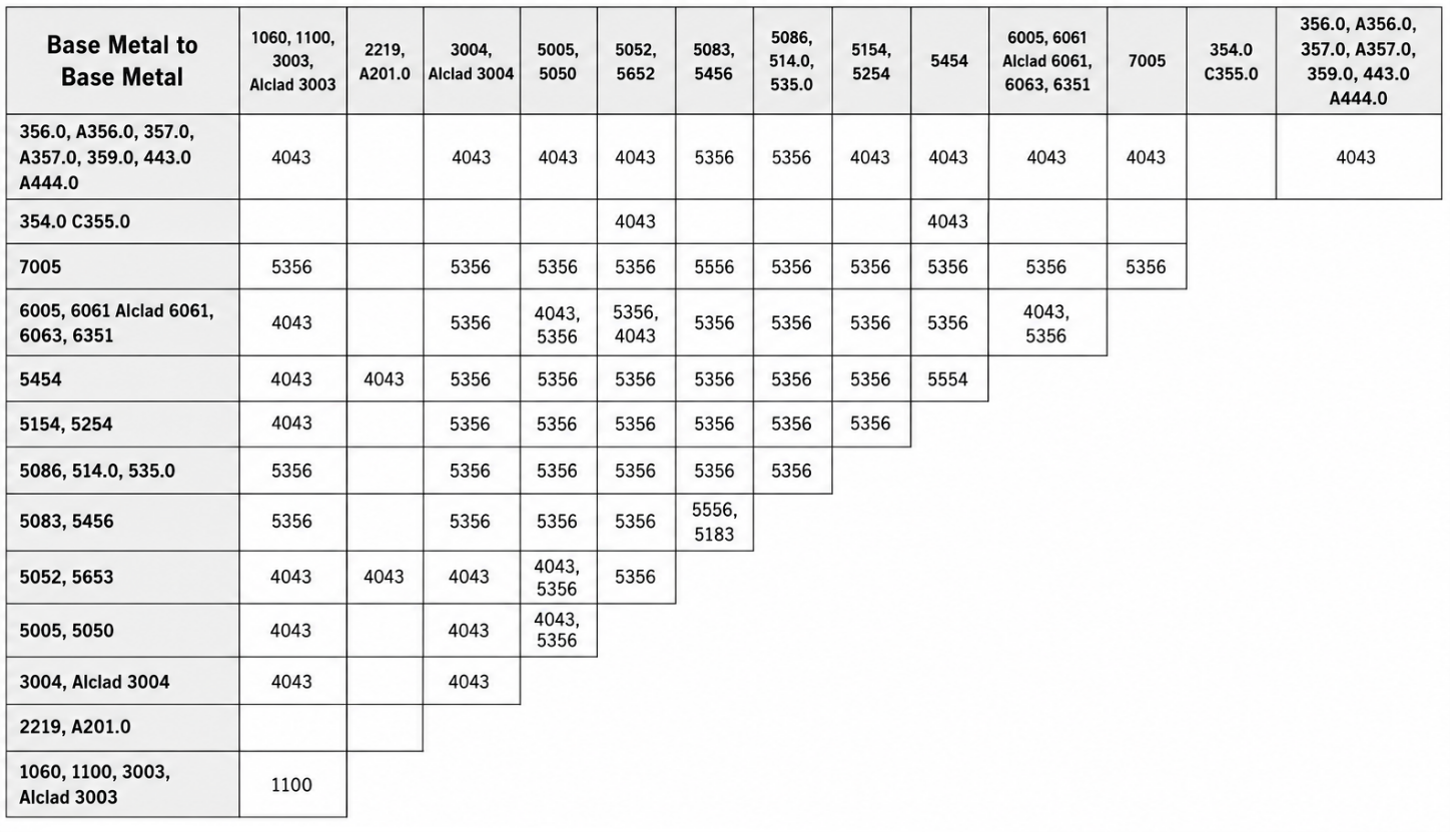
Executive 5356 generally provides greater ductility and toughness than Executive 4043. If a welded component will be formed, bent or subjected to significant movement after welding, this may favour the use of 5356. Greater ductility and toughness can also be beneficial in applications where resistance to crack propagation, fatigue or repeated loading is important. Again, the cross-reference chart should be checked first to confirm that 5356 is suitable for the base-metal combination.
For MIG welding, Executive 5356 normally has an advantage in feedability. 5356 is a stiffer wire with greater column strength than 4043. This makes it somewhat more resistant to buckling during feeding and can make it easier to push through a welding gun. Executive 4043 is softer and may require more attention to the wire-feed system, particularly with longer gun lengths. Proper drive rolls, liners, contact tips and aluminum feeding equipment remain important regardless of which alloy is being used.
One of the reasons welders often like Executive 4043 is the way it welds. The silicon content of 4043 lowers its melting temperature and improves fluidity. This typically provides excellent wetting action and a smooth weld bead. Executive 4043 also tends to produce less black smut and discoloration than 5356. Executive 5356 can produce more black residue around the weld because of its magnesium content. This does not necessarily mean there is anything wrong with the weld. Proper cleaning, shielding gas coverage and welding parameters can help minimize it.
Executive 4043 is generally less sensitive to hot cracking in many of the common applications where either 4043 or 5356 can be used. Its higher silicon content also gives it a lower shrinkage rate, which can help reduce weld distortion. For assemblies where distortion or hot-cracking sensitivity is a concern, these characteristics can make Executive 4043 particularly attractive.
| Advantages of Executive 4043 | Advantages of Executive 5356 |
|
|
In many general fabrication applications where either alloy is acceptable, the choice may ultimately come down to the welder and the application. Some welders prefer the fluidity and wetting characteristics of Executive 4043, while others prefer the strength and feedability of Executive 5356.
For informational purposes only. Due to the many variables in manufacturing and application, Executive Filler Metals makes no specific product recommendations or warranties. Users should consult their appropriate internal technical departments to confirm suitability for their application.